
Goldmund
Founded in France in 1978, Goldmund has spent more than four decades pursuing the goal of reproducing music and sound with exceptional precision, transparency, and realism. The company began with the development of the T3 servo-controlled tonearm before introducing its direct-drive Studio turntable in 1979, featuring Goldmund’s pioneering Mechanical Grounding technology. In 1980, founder Michel Reverchon acquired the company and relocated it to Geneva, Switzerland, establishing the Swiss foundation that remains central to Goldmund’s identity today. Goldmund went on to develop some of the most recognizable products in high-end audio, including the Reference turntable, Mimesis electronics, the Apologue loudspeaker, and the Telos amplifier series. The company’s history reflects a consistent willingness to pursue new engineering solutions rather than simply follow established industry conventions.
Goldmund’s philosophy is built around the idea that a truly accurate audio system should add as little of its own character as possible. The company describes its approach as a pursuit of the most precise and lifelike reproduction possible, with particular attention to frequency response, phase response, and time response. This emphasis on time and mechanical behavior is central to Goldmund’s engineering philosophy. Mechanical Grounding, introduced in the early years of the company, is designed to control and evacuate unwanted vibrations from the structure of an audio component, reducing resonance and coloration. Goldmund combines this mechanical approach with extensive mathematical modeling, digital signal processing, and carefully controlled amplification to address sources of distortion throughout the signal chain. The result is an engineering philosophy in which mechanical construction, electronics, software, and acoustics are treated as interconnected parts of a single system.
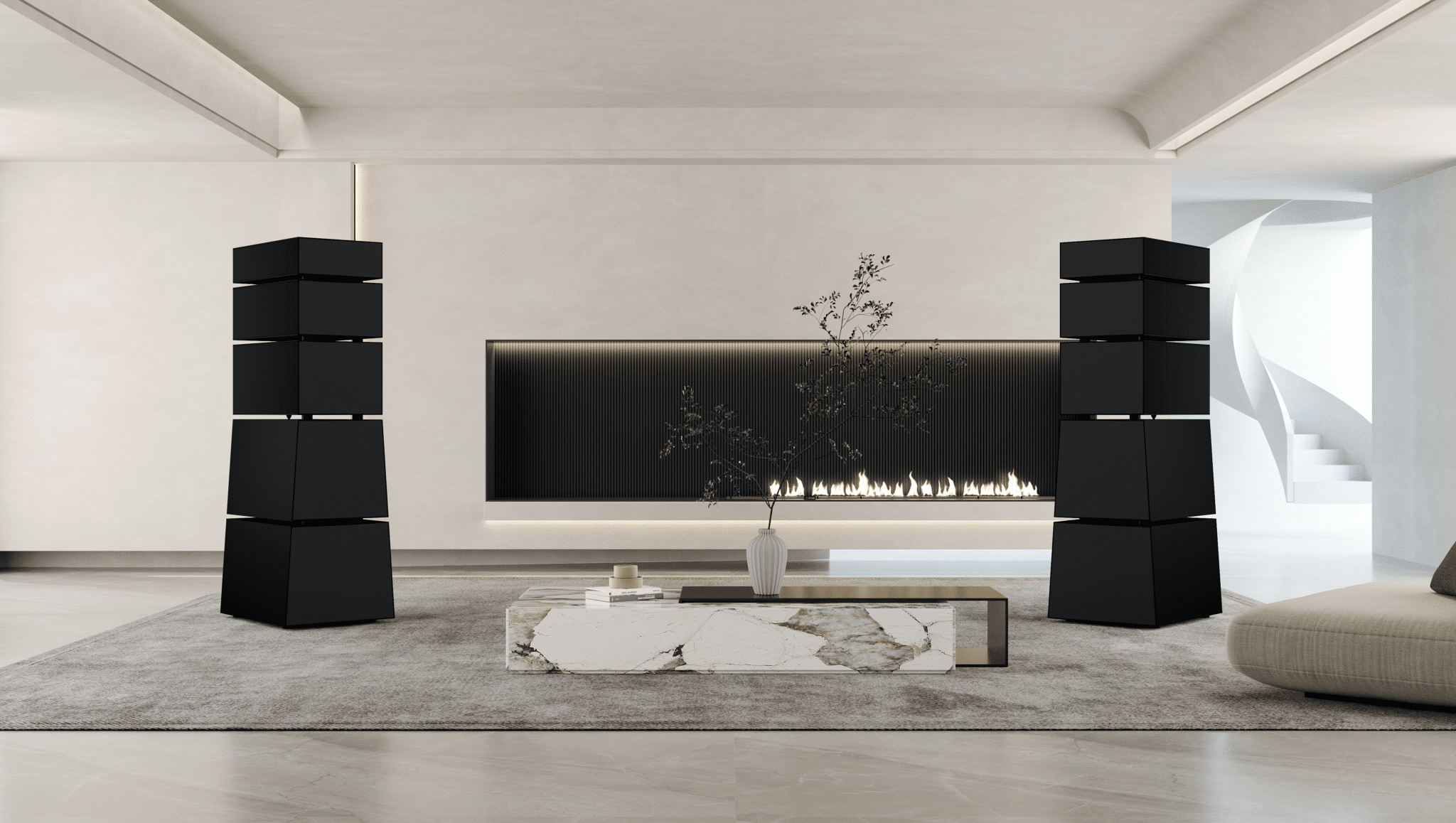
Goldmund has developed a number of proprietary technologies that define its modern product range. Proteus LS is a mathematical loudspeaker-modeling system used to optimize enclosure design, driver positioning, diffraction, and other parameters before a speaker is produced. Goldmund’s Leonardo DSP technology applies precise digital corrections to address phase and time-domain behavior, while its active loudspeakers use dedicated amplification and digital filtering to give the electronics direct control over individual drivers. Telos amplification technology focuses on extremely low output impedance, high bandwidth, and precise driver control, particularly in the demanding low-frequency range. Alize, Goldmund’s digital-to-analog technology, was developed around time coherence and extremely low timing error. These technologies appear across a product portfolio spanning loudspeakers, integrated and separate amplification, digital sources, preamplifiers, and complete high-end home theater systems.
Goldmund’s approach extends beyond circuitry and software to the physical construction of its products. The company carefully selects materials such as aluminum, copper, gold, resin, Delrin, and specialized damping materials for both their mechanical and aesthetic properties. Aluminum, for example, is used for its rigidity and robustness, while resin and other high-density materials help control unwanted vibration and resonance. This combination of precision engineering, material selection, Swiss craftsmanship, and distinctive modernist design has made Goldmund one of the most recognizable names in the ultra-high-end audio industry. From its early analog innovations to its modern active loudspeakers, digital processing, amplification, and luxury home theater systems, Goldmund continues to pursue the same fundamental objective: allowing music and film to be experienced with as little interference between the recording and the listener as possible.